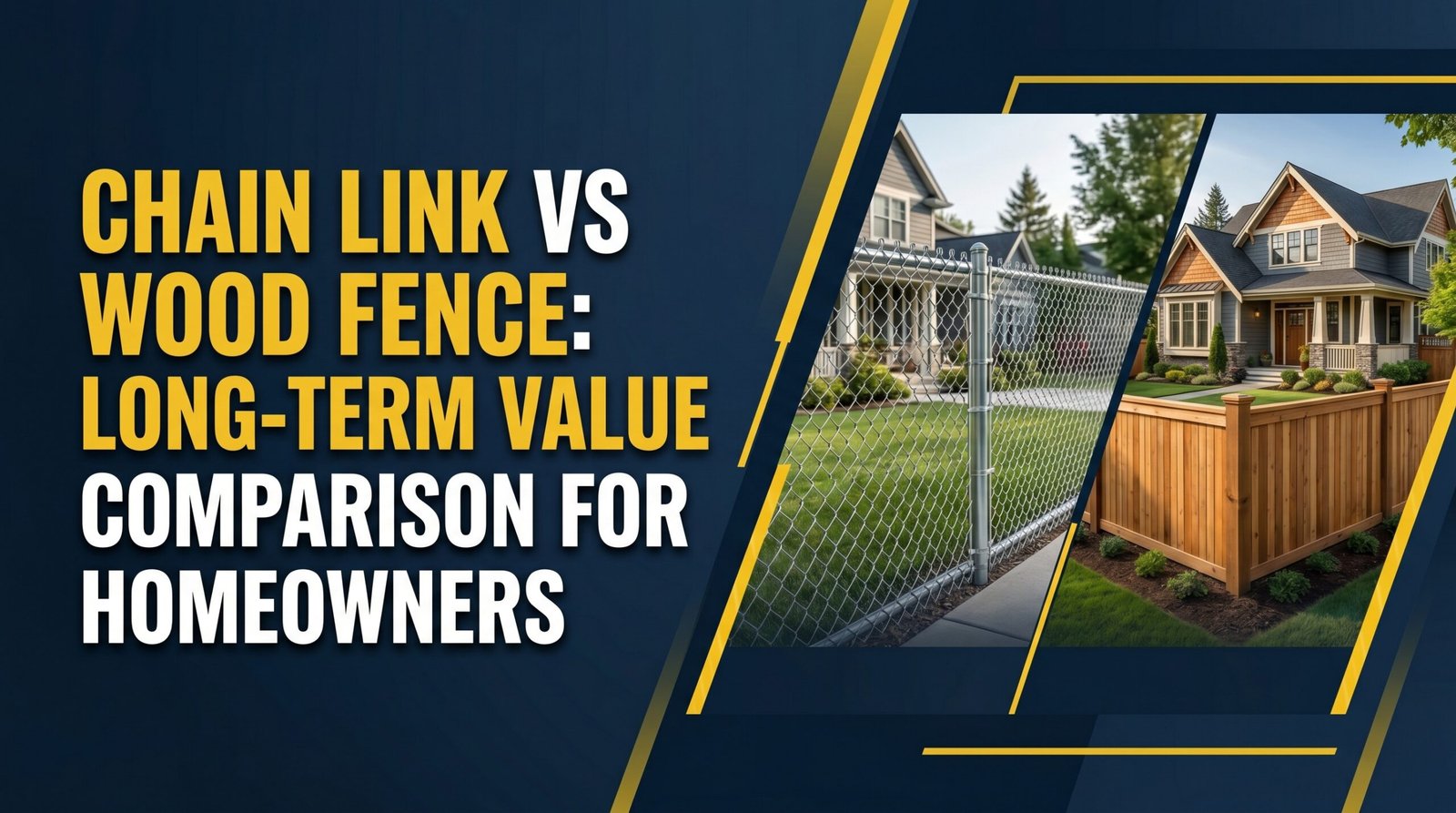
Homeowners replacing or installing new fencing consistently face the same comparison: chain link or wood. Both materials have legitimate claims on the market, and both serve specific property needs effectively.
An Asheville wood fence carries a particular aesthetic resonance in residential neighborhoods where natural materials align with the architecture and landscaping. Chain link brings a different set of strengths to the same comparison.
The decision that holds up over time is the one made with a complete picture of installation costs, maintenance demands, lifespan projections, and the practical performance each material delivers across years of actual use.
Chain Link vs Wood Fence Cost Over Time
Installation Expenses Compared
Chain link vs wood fence cost comparisons frequently begin and end at installation pricing, which misses the more significant financial picture. Wood fencing carries a higher installation cost per foot in most configurations due to material costs and the labor required for post setting, panel assembly, and the finish work that wood demands at installation.
Chain link installs faster and at lower cost per foot, particularly over large areas. The material savings are most pronounced on commercial-scale projects where total fence length makes per-foot cost differences add up quickly. For residential installations on modest lot sizes, the installation cost gap is real but less dramatic.
Maintenance Costs Add Up Differently
Maintenance is where the long-term cost comparison separates the two materials most clearly. Wood fencing requires regular sealing or staining to maintain structural integrity. Without that treatment, moisture penetrates the wood fibers, accelerating rot, warping, and insect infiltration that progressively compromise the fence’s performance and appearance.
Chain link requires minimal ongoing maintenance. The galvanized coating protects against corrosion without annual reapplication. Occasional hardware checks and tension adjustments represent the typical maintenance requirement over a decade of service. The maintenance cost gap between the two materials widens considerably over a ten-year ownership period.
Lifespan Impacts Long-Term Value
A well-maintained wood fence typically lasts 15 to 20 years before requiring significant structural repairs or full replacement. Chain link installations regularly exceed 20 years of service life with minimal intervention. That additional service life means the lower initial cost of chain link extends further into the future, improving its total value proposition relative to wood.
• Wood requires sealing every two to three years to prevent moisture infiltration that causes warping, cracking, and rot at post bases
• Chain link resists moisture through galvanized or vinyl-coated steel that maintains its protective layer without annual reapplication
• Wood offers privacy through solid panel construction that blocks sightlines completely, which is a functional benefit chain link cannot match without added slats or screening
• Chain link lowers maintenance demands over the full ownership period, reducing the recurring cost that makes wood increasingly expensive relative to its initial installation price
Commercial Wood Fences vs Chain Link for Security
Privacy Needs for Commercial Spaces
Commercial wood fences serve specific functions that chain link cannot replicate without modification. Industrial sites that need to screen equipment, inventory, or operational activity from public view depend on solid barrier fencing. Commercial wood fences provide that screening while also dampening sound and reducing dust transfer across property boundaries.
The structural demands on commercial fencing exceed residential applications in every category. Post spacing, anchoring depth, and panel construction must account for higher wind loads, more frequent gate cycling, and the physical stress of commercial operational environments. Wood and chain link both meet these demands but through different structural strategies.
Durability Under Heavy Use
Commercial applications subject fencing to heavier sustained use than residential installations experience. Vehicle proximity, equipment staging, and high foot traffic all accelerate the wear that fencing materials experience at post bases, panel lower sections, and gate hardware. Chain link’s galvanized steel construction handles this wear with less visible deterioration than wood.
Wood panels at commercial sites that experience vehicle proximity or equipment contact require more frequent inspection and repair. The material’s susceptibility to impact damage makes it a higher-maintenance choice in industrial and logistics environments. Chain link absorbs similar impacts with greater structural resilience and recovers from minor damage without requiring panel replacement.
Visibility and Access Control
Chain link’s open structure serves commercial security by maintaining perimeter visibility from guard positions and surveillance cameras. Solid wood panels create blind spots along the fence line that reduce monitoring effectiveness. For commercial sites where perimeter visibility matters, chain link outperforms wood without modification.
Access control gates in commercial chain link fencing can accommodate sliding, cantilever, and swing configurations that handle the vehicle access requirements of industrial operations. Gate sizing and hardware specifications for commercial chain link installations differ substantially from residential applications and require contractor experience at that scale.
Why Residential Chain Link Fence Gate Systems Stay Popular
Better Durability for Families and Pets
Residential chain link fence gate installations remain consistently popular because the material handles the physical demands of active family use better than most alternatives. Children, dogs, sports equipment, and lawn maintenance all subject residential fencing to repeated impact and mechanical stress that wood and vinyl accumulate into visible damage over time.
Chain link absorbs that activity without developing the permanent deformation that marks other materials. A panel that deflects under impact returns to its original profile when the pressure releases. That resilience is not just a performance characteristic. It is the reason chain link fences in active family yards look structurally sound years after wood alternatives would show significant wear.
Lower Repair Requirements
Repair frequency matters to homeowners in practical, financial terms. Wood panels that experience moisture damage, impact, or post rot require individual panel replacement or post resetting that generates meaningful repair costs. Chain link damage is typically limited to the mesh section or specific hardware component involved, which produces lower repair costs per incident.
The lower repair frequency of chain link fencing compounds its value advantage over wood across extended ownership periods. Fewer service calls, less material replacement, and minimal annual maintenance combine to create a total cost of ownership that compares favorably with materials that appear more economical at the point of initial installation.
Improved Modern Designs
The contemporary chain link fence market offers homeowners design options that the material was not associated with a decade ago. Vinyl coatings in black, dark green, and brown allow chain link to recede into landscaping rather than standing out as an industrial presence. Post cap options, rail configurations, and privacy slat systems expand the aesthetic range further.
Modern chain link designs satisfy homeowners who want containment durability without sacrificing curb appeal. The combination of improved aesthetics with the material’s inherent durability and low maintenance characteristics makes contemporary chain link a genuinely competitive option in residential markets where wood once dominated by default.
Long-term value in fencing comes from matching material characteristics to actual property requirements. Chain link and wood each serve specific needs effectively, but the honest comparison across installation cost, maintenance demand, and service life consistently favors chain link for property owners prioritizing total value.
Asheville Chain Link & Fencing Service helps every client make that comparison with complete information.